Carbon Fiber Wall Reinforcement: What It Does, What It Doesn't, and When It Fits
That horizontal crack creeping across your block wall isn’t cosmetic. Neither is the slight inward lean near the center of the wall. Foundation walls rarely settle back on their own, and here in Southeast Michigan, our soil and weather keep the pressure on year after year.
We’re Perma Dry Michigan, a family-owned team serving Plymouth, Canton, Livonia, Detroit, Westland, Romulus, Ypsilanti, and nearby communities. We’ve inspected basements across the region for years, and we know what our ground does to foundation walls. Here’s what you’ll take away:
- Why walls bow so often in our region
- What carbon fiber does, and what it doesn’t
- When carbon fiber fits, and when steel or anchors fit better
- The warning signs worth acting on now
Why Bowing Basement Walls Are So Common in Southeast Michigan
Our region sits on heavy, expansive clay soil. That’s the root of the problem, and it’s the piece many contractor pages skip. You can’t understand your wall without it.
Clay Soil Puts Constant Pressure on Foundation Walls
Clay absorbs water and swells. When it dries, it shrinks. That endless push-and-pull presses against your foundation walls season after season. When the force exceeds a wall’s strength, the wall can crack and move inward.
Water Saturation and Snowmelt Drive Hydrostatic Pressure
Spring snowmelt and heavy rain saturates the soil around your foundation. Saturated soil creates hydrostatic pressure, the weight of water-logged ground pushing against your walls from outside. Poor drainage makes it worse, and it’s a common driver of both wall movement and water seepage.
Freeze-Thaw Cycles Add Repeated Stress
Water in the soil freezes, expands, then thaws again and again through a Michigan winter. Each freeze-thaw cycle drives more lateral force against block and poured concrete walls. Over time, that cyclical stress can deepen cracks and increase the bow.
Older Homes Often Show Signs First
Warning Signs Worth Watching
Catch these early and you usually keep the repair simpler:
- Horizontal wall cracks across block or concrete, often the clearest warning
- Inward bowing or leaning near the center of the wall
- Sticking doors or windows on the floors above
- Sloping or uneven floors
- Water seepage along cracks or the floor line
- Musty smells signaling trapped moisture
Movement and moisture often travel together. If water is getting in, the same pressure driving that water may be pushing your wall. That’s why smart basement waterproofing services belong in the same conversation as structural repair.
What Carbon Fiber Basement Wall Reinforcement Does
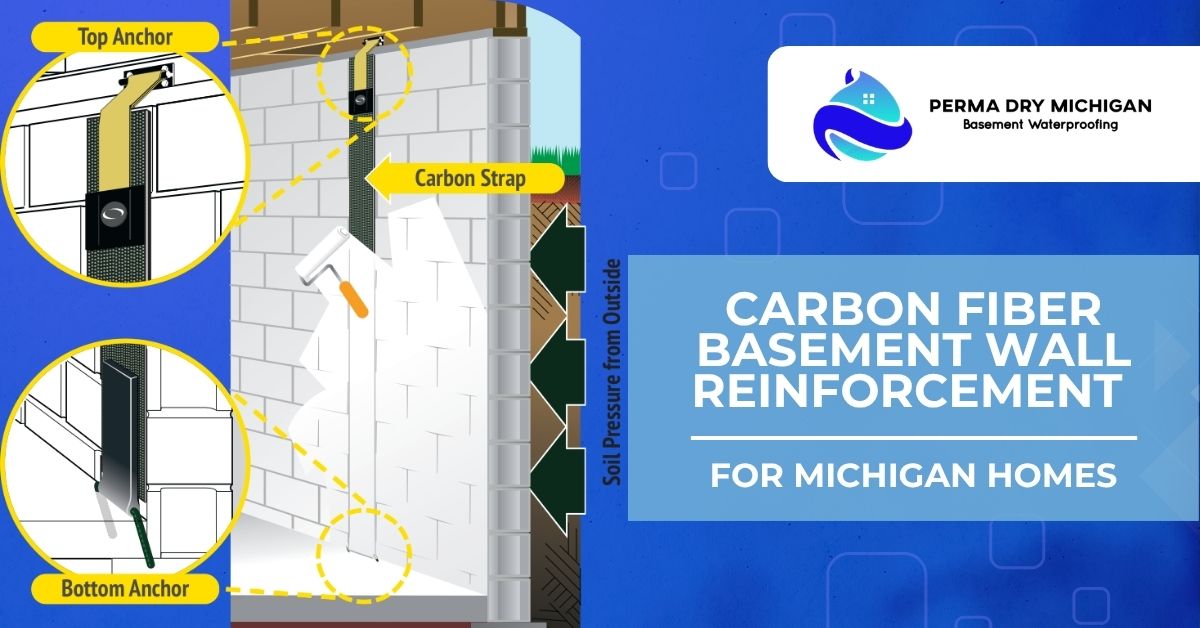
Carbon fiber straps bond to the interior face of your foundation wall. Once cured and anchored, they help hold the wall in place and resist further inward bowing. Carbon fiber offers high tensile strength for its weight, and it doesn’t rust.
We install the Fortress InvisiBeam system, engineered with a blend of carbon fiber and Kevlar grid straps. InvisiBeam anchors to the rim joist at the top and the footer at the bottom. That engages your home’s floor system for a stronger hold than straps that only adhere to the wall surface.
A few reasons we trust it for foundation wall reinforcement:
- Ultra-thin and low profile, so you can paint over it or hide it behind a finished wall
- Won’t corrode, unlike steel sitting in a damp basement for years
- ICC-ES certified, meaning it’s been evaluated against recognized building-code criteria
- Efficient installation with minimal mess or disruption
InvisiBeam was among the first carbon fiber wall reinforcement systems to earn ICC-ES certification, and that third-party review matters when you’re protecting your home.
What Carbon Fiber Doesn't Do
Honesty is part of our job, and it’s where too many contractor pages fall short. Carbon fiber isn’t magic.
It’s designed to resist further inward movement, not to push a wall back to plumb. Straps alone won’t straighten a wall that has already moved significantly, and they aren’t the right answer for every situation. Anchoring to the structure at the top and bottom is essential, because a bonded strap without proper anchoring can still let a wall tip or slide under continued soil load.
When Carbon Fiber Is Often the Right Fix
Carbon fiber wall repair tends to perform best on early to moderate inward movement. When a wall shows a horizontal crack with limited displacement, carbon fiber straps can be an excellent, minimally invasive way to stabilize it, and they’re well suited to finished basements.
Situations where it often fits:
- Early to moderate bowing
- A horizontal crack with limited inward displacement
- Finished basements where visual impact matters
- Block or poured concrete foundation walls in otherwise sound condition
The right call always depends on wall condition, movement pattern, wall material, and site conditions. If you’re seeing a horizontal crack or a slight inward bow right now, this is the moment to act. Schedule a free inspection before a simple fix turns into a larger project.
When Steel I-Beams or Wall Anchors May Be Better
When bowing is more advanced, or when a wall is tipping or shearing, straps alone often aren’t enough. Here’s how the other proven methods compare.
Steel I-beams provide heavy-duty support for walls that have moved more significantly. We typically place them a few feet apart, braced at the footer and joists, to resist further inward movement.
Wall anchors can help recover lost wall position over time or with exterior excavation, using stable soil beyond your foundation as the anchor point. They’re worth considering when straightening, not just stabilizing, is the goal, and when site conditions support it.
| Repair Method | Best For | Can It Straighten the Wall | Disruption | Visual Impact | Michigan Notes |
|---|---|---|---|---|---|
| Carbon Fiber (InvisiBeam) | Early to moderate bowing, horizontal cracks | Generally no, it resists movement | Low, interior only | Ultra-thin, easily hidden | Suited to finished basements, won’t corrode in damp conditions |
| Steel I-Beams | Moderate to more advanced bowing or buckling | Generally no, it braces in place | Moderate, interior | Takes up several inches of space | Fast bracing, can corrode over time in wet basements |
| Wall Anchors | Advanced bowing where straightening is the goal | Often yes, over time or with excavation | Higher, needs exterior soil work | Small interior plates | Depends on stable exterior soil and yard access |
The right answer depends on how far your wall has moved and why. That’s exactly what our inspection determines. Explore every option on our basement wall stabilization page.
Why Honest Basement Wall Stabilization Advice Matters
Plenty of pages oversimplify carbon fiber, treating it as a one-size-fits-all cure. They skip Michigan’s soil and weather factors, gloss over when steel or anchors work better, and separate wall movement from water management when the two often overlap. That leaves homeowners guessing.
We take a different approach. We inspect first, recommend based on wall condition, and pair structural repair with moisture control when the situation calls for it. If carbon fiber is right, we’ll say so. If it isn’t, we’ll explain the better option in plain language.
How Perma Dry Michigan Evaluates Your Wall
Every project starts with a free, no-pressure inspection, so you know what your wall needs and what it doesn’t.
What We Look For
- Wall type, whether block or poured concrete
- Crack pattern, especially horizontal wall cracks
- Degree and direction of inward movement
- Water intrusion or seepage
- Exterior pressure sources and drainage issues
- Whether the wall is bowing, tipping, or shearing
What Installation Typically Involves
We prepare the interior surface, place the carbon fiber straps, and anchor them to the rim joist and footer. The finish stays low profile, so you can paint over it or frame a shallow wall in front. Most projects move efficiently with limited disruption to your home.
When We Recommend Waterproofing or Crack Repair
If cracks are letting water in, we handle foundation crack repair to seal the entry points and protect the wall long term. When moisture is part of the problem, we fold basement waterproofing into the plan so the fix holds up.
Why Southeast Michigan Homeowners Trust Perma Dry Michigan
We’re a family-owned, locally operated company rooted right here in Southeast Michigan. We serve all of Southeast Michigan, and we know these neighborhoods and their soil firsthand.
You get straight answers, transparent pricing, and financing options that keep repair affordable. We hold an A+ BBB Accreditation, and we treat your home like our own. Want to meet the team behind the work? Get to know us on our about Perma Dry Michigan page.
Don't Let a Small Bow Become a Bigger Repair | Schedule An Estimate
Bowing basement walls tend to worsen when ignored, and Mcihgian’s clay soil, freeze-thaw cycles, and hydrostatic pressure keep the pressure on. Carbon fiber basement wall reinforcement can stop early to moderate bowing with minimal disruption, while steel I-beams or wall anchors handle tougher cases. The key is an honest diagnosis from a local team that knows your ground.
Don’t wait for that crack to widen. Book your free inspection with Perma Dry Michigan today. We’ll tell you whether carbon fiber is the right fix, and if it isn’t, we’ll walk you through the better one.
Frequently Asked Questions About Carbon Fiber Basement Wall Reinforcement
It’s a basement wall stabilization method that bonds high-strength carbon fiber straps to the interior of a foundation wall. Once cured and anchored, the straps help hold the wall in place and resist further inward bowing.
When properly installed and anchored, carbon fiber wall repair is designed to be a long-term solution that resists further inward movement. The InvisiBeam system anchors to the rim joist and footer, and carbon fiber won’t corrode the way steel can in a damp basement.
Generally, no. Carbon fiber is designed to resist further inward movement, not to push a wall back to plumb. If straightening is your goal, wall anchors or exterior excavation are usually the better bowing foundation wall repair options.
Steel I-beams are often the stronger choice for more advanced bowing, buckling, tipping, or shearing. Carbon fiber tends to fit early to moderate inward movement. An inspection confirms which method suits your wall.
Our expansive clay soil swells with water and shrinks when dry, while freeze-thaw cycles and snowmelt add hydrostatic pressure. That repeated force pushes foundation walls inward, especially in older homes.
Often, yes. Water seepage and soil pressure frequently travel together. When moisture is part of the problem, pairing basement wall stabilization with basement waterproofing helps protect the repair and keep your basement dry.
Disclaimer: Every foundation wall is different. The right repair method depends on wall condition, movement pattern, site conditions, and moisture factors, which is why we recommend a professional inspection before choosing a solution.