Why Your Basement Wall Has Round Holes and What to Do About Them
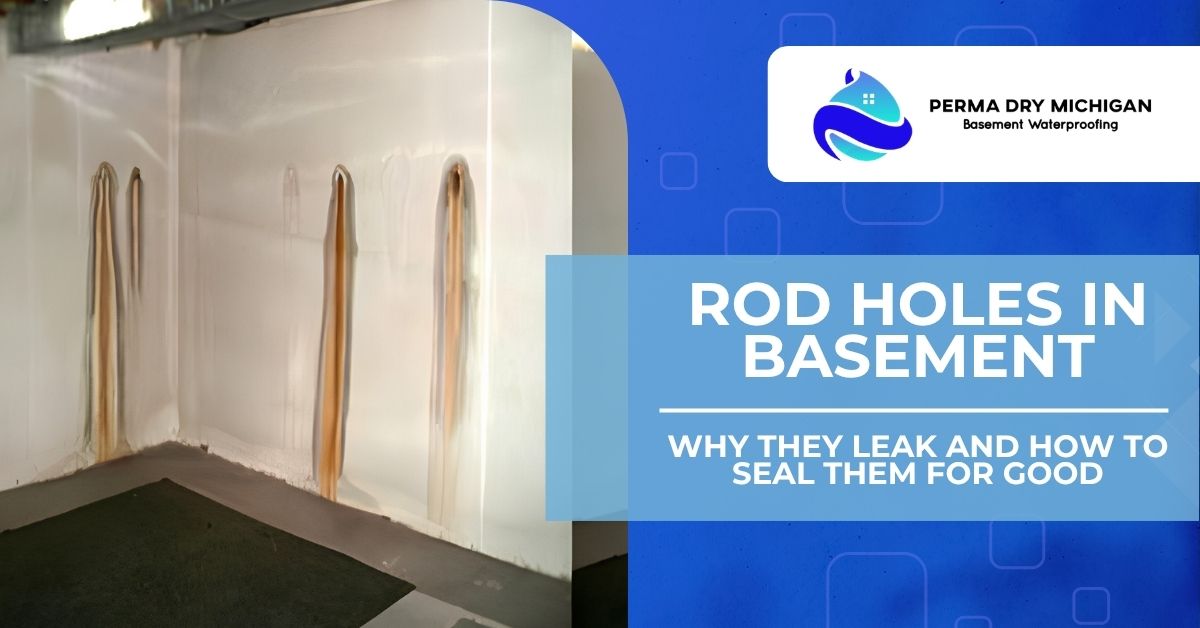
You head downstairs after a long Michigan rain and see it: a small round wet mark on the basement wall, maybe a rust-colored drip trailing toward the floor. You wipe it dry. Days later, it’s back. That tiny opening isn’t cosmetic. It’s a direct channel letting groundwater into your home.
We’re Perma Dry Michigan, a licensed and certified basement waterproofing team serving Plymouth, Romulus, Ypsilanti, the Downriver communities, and the rest of Southeast Michigan. We’ve diagnosed and sealed these leaks in poured concrete basements across the region. Here’s exactly what rod holes are, why they leak, and how we stop them for good.
What Are Rod Holes in a Basement?
Rod holes come from the way poured concrete foundations get built. Crews use steel tie rods to hold the wall forms in place while the concrete cures. Once the forms come off, those rods leave behind small, evenly spaced holes across the wall.
Builders are supposed to fill these openings, which contractors call tie rod holes or form-tie holes. The trouble is that many original fills were rushed, cheap, or applied only on the surface. Over the years, they shrink, crack, or wash out completely.
That leaves a straight path from the wet soil outside directly into your basement. You’ll usually spot these holes in a repeating, predictable line.
How to Recognize a Leaking Rod Hole
Watch for these telltale signs on a poured concrete wall:
- Small, round holes in a straight, repeating line
- Rust-colored staining running down from the opening
- Damp spots that appear or worsen after rain
- White, chalky mineral deposits, known as efflorescence, around the hole
- A recurring wet patch that returns no matter how often you patch it
If any of these looks familiar, you’re likely dealing with a form tie hole leak.
Why Rod Holes Leak and Get Worse Over Time
The main driver is hydrostatic pressure. When rain saturates the soil around your foundation, that water has nowhere to drain. It builds pressure against your basement walls and pushes hard against every weak point, including old rod holes.
Water always finds the path of least resistance. A failed rod hole patch offers exactly that. Each storm forces more water through the same opening, widening the channel over time.
Southeast Michigan makes the problem worse for a few specific reasons:
- Heavy seasonal rain saturates soil fast and raises the water table.
- Clay-heavy soils hold water against foundation walls instead of letting it drain.
- Freeze-thaw cycles expand and contract the ground, stressing old patches and widening gaps.
- Older housing stock in communities like Plymouth and Downriver often carries original, failing rod hole fills.
A small leak rarely stays small here. Our wet springs and hard winters guarantee repeated pressure against the same weak point.
Why Surface Patching Usually Fails
Grabbing a tube of hydraulic cement from the hardware store feels like a quick win. It almost never lasts.
Surface patches cover only the interior opening. They don’t seal the full channel running through the wall. The next time drainage pressure spikes, water finds the same path and pushes the patch loose from behind.
For a repair that holds, you must seal the entire depth of the hole, not just the face you can see. That single distinction separates a fix that lasts from one you’ll redo next spring.
Reading the Symptoms: Cause, Recurrence, and the Right Fix
Different basement leaks point to different causes. Use this quick reference to understand what you’re likely seeing and what solves it long-term.
| Basement Symptom | Likely Cause | Why It Keeps Coming Back | Best Long-Term Fix |
|---|---|---|---|
| Small round leak in a straight line | Failed tie rod or form-tie hole fill | Surface patch covers only the interior face | Full-depth polyurethane injection |
| Rust-colored drip from a wall spot | Steel tie rod remnant corroding as water flows | Moisture keeps reaching the metal | Seal the hole to cut off water contact |
| Vertical crack seeping water | Foundation crack under pressure | Cracks reopen with soil movement | Professional crack injection |
| White chalky buildup on the wall | Efflorescence from mineral-laden seepage | Water keeps evaporating through the wall | Address the seepage source, then waterproof |
| Widespread dampness after every storm | Broad hydrostatic pressure and drainage issues | One patch can’t relieve wall pressure | Full basement waterproofing system |
How Polyurethane Injection Seals Rod Holes for Good
We seal rod holes with polyurethane injection, a material engineered for exactly this problem. It works where patching fails because it fills the whole cavity, not just the surface.
The material expands to reach every void inside the hole, then cures into a flexible seal. That flexibility matters in a freeze-thaw climate like ours, because the seal moves with your foundation instead of cracking against it.
The result is a closed leak pathway, not a hidden one. Water no longer has a channel to travel through.
When One Leak Signals a Bigger Waterproofing Problem
Sometimes a single rod hole is the whole story. Other times, it’s the first symptom of broader water intrusion.
If you also see efflorescence across multiple areas, dampness after every storm, or seepage near the floor-wall joint, hydrostatic pressure may be pushing against the entire wall. Sealing one hole won’t be enough.
That’s why every repair we do starts with a proper diagnosis. Basement moisture carries real health risks, and the U.S. Environmental Protection Agency links chronic dampness to mold growth that harms indoor air quality. Sealing leaks early protect your home, your health, and your property value.
Signs You're Likely Dealing with Rod Holes
Run through this quick checklist:
- The opening is small and round.
- The marks repeat in a straight, even line across the wall.
- The leak appears or worsens after heavy rain.
- Rust or mineral staining trails below the spot.
- Previous patches have already failed.
Check three or more boxes, and a tie rod hole leak is the likely culprit and a free estimate should be scheduled.
How Perma Dry Michigan Fixes Rod Hole Leaks
Our approach stays practical and transparent from the first visit:
- A free, no-obligation inspection. We locate every leaking hole and check for related issues.
- Targeted tie rod hole leak repair. We inject high-quality polyurethane to seal each opening through its full depth.
- A broader moisture check. If the symptoms point to wider intrusion, we’ll walk you through your options for basement waterproofing.
- Related repairs where needed. We also handle foundation crack repair and crawlspace solutions and repair when a leak signals more than one weak point.
We focus on poured concrete foundations throughout Southeast Michigan, and we tailor every fix to local soil and weather. That local knowledge means we understand how our clay soils, wet springs, and freeze-thaw winters work against your basement.
Homeowners across the region trust us for fast, efficient service backed by clear pricing and workmanship we stand behind. We’re BBB-accredited, licensed, and certified, and our goal on every job stays simple: restore your comfort, protect your home’s structure, and preserve its value.
Stop the Leak Before the Next Storm with Perma Dry Michigan
Rod holes are a small problem with big potential for damage. The good news: they’re highly fixable when handled correctly. A proper polyurethane injection seals the leak permanently, so you can stop drying up water and start using your basement again.
Don’t wait for the next heavy rain to make it worse. If you’re seeing rust-colored drips, round wet spots, or recurring wall seepage on a poured concrete wall, we can help. Southeast Michigan homeowners searching for basement waterproofing land with us for a reason: we diagnose the real cause and fix it once.
Schedule your free estimate with Perma Dry Michigan or call us at (734) 800-1355 today. We’ll diagnose the issue, explain your options in plain English, and seal the leak for good.
Frequently Asked Questions About Rod Holes in Basement
That small hole is likely a tie rod hole left over from construction. When its original patch fails, hydrostatic pressure from saturated soil pushes groundwater straight through the opening, especially after heavy rain.
Yes. Homeowners call them rod holes, while contractors call them tie rod holes or form-tie holes. They’re the small, round openings left in poured concrete walls where steel form rods once sat.
Rain saturates the soil around your foundation and builds hydrostatic pressure against the walls. That pressure forces water through weak points like rod holes, so leaks appear or intensify during Southeast Michigan storms.
You can try a hardware store patch, but it usually fails because it seals only the interior surface. Water finds the same channel under pressure. Professional polyurethane injection seals the full depth for a lasting fix.
It depends on the diagnosis. A single leaking hole often needs only targeted repair. Widespread dampness, efflorescence, or floor-joint seepage may signal broader pressure that calls for a complete basement waterproofing system.
Yes. Even small leaks can cause mold, wood rot, and moisture damage over time. Sealing them early protects your basement’s usability, your home’s structure, and your family’s health.
We serve homeowners across Southeast Michigan, including Plymouth, Romulus, Ypsilanti, Southfield, and the Downriver communities. Contact us to confirm service for your location and schedule a free estimate.
Disclaimer: This article is for general educational purposes only and does not replace an in-person inspection or project-specific waterproofing recommendation. Basement leak conditions vary by foundation type, site drainage, soil conditions, and prior repairs. For an accurate diagnosis and repair plan, schedule a professional inspection with Perma Dry Michigan.